
Allgemein
High-Speed Internet Helps Populist Parties
The spread of broadband internet and the electoral success of populist parties are closely related, researchers Max Schaub of the Berlin Social Science Center (WZB) and Davide Morisi (Collegio Carlo Alberto) show in a study focusing on the AfD in Germany and the Five Star Movement (M5S) in Italy. The study demonstrates that it is possible to draw a…
Read MoreNew Research To Explore Governance Of Emerging Technologies

The new research programme aims to scientifically investigate the legal, ethical and technical aspects of AI, machine learning and other emerging information technologies. This new programme is coordinated by Prof. Sandra Wachter, a legal scholar; Dr. Brent Mittelstadt, an ethicist; and Dr. Chris Russell – a specialist in machine learning. Working across this trinity of disciplines the programme will…
Read MoreNRW Institute for Digitalization Research

The state government of North Rhine-Westphalia wants to support universities and research institutions with an institute for digitalization research that develops and bundles competencies and makes them nationally and internationally visible. The Institute’s mission is to actively participate in the social and technological shaping of digital transformation, focusing on the potentials and challenges for people.
Read MoreCAIS conducts Delphi study on digitalization research in North Rhine-Westphalia

In a Delphi study, the Center for Advanced Internet Studies (CAIS) is currently interviewing scientific experts in NRW about the perspectives and challenges of digitalization research. The results should help to focus and organize future research in the field of digitization and artificial intelligence.
Read MoreA ‘Disinformation ABC’ & other strategies to address malevolent speech online
“Governments should refrain from triggering the removal of undesirable, but legal, content, as such action is inconsistent with freedom of expression,” said Susan Ness, the group’s co-chair and founder, in releasing a report and a set of working papers concerning U.S. and EU efforts to control disinformation. In their second set of working papers, members…
Read MoreResearch Impact Canvas: New tool for impactful science communication
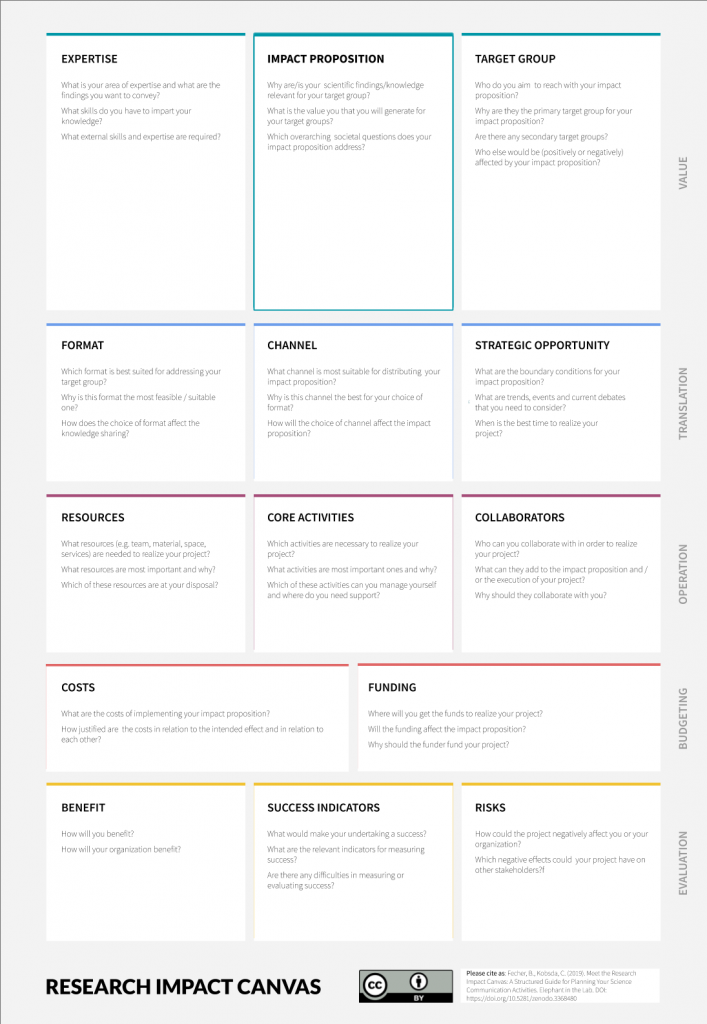
With the help of the newly developed science communication tool Research Impact Canvas, HIIG trains PhD students and postdocs in knowledge transfer during its three day long international Impact School.
Read MoreHow SMEs successfully tackle digitalisation
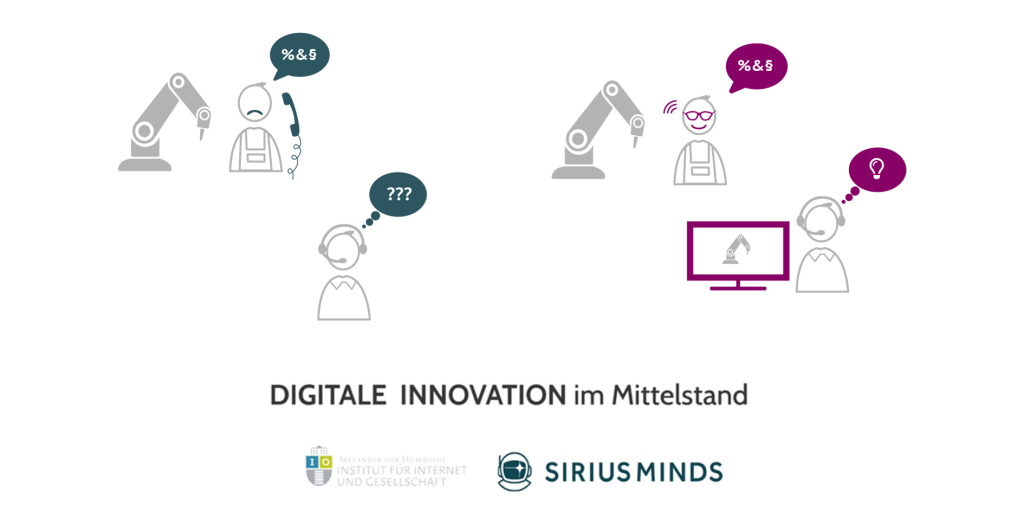
A study by the Alexander von Humboldt Institute for Internet and Society (HIIG) and Sirius Minds analysed how small and medium-sized enterprises tackle the digital transformation. Berlin, 28. März 2019 – Ob intelligente Müllentsorgung mittels einer Smartphone-App, der Aufbau einer Internet of Things-Plattform zu Zwecken der Produktivitätssteigerung oder Smart Glasses für besseren Kundenservice: Im deutschen Mittelstand…
Read MoreDFG supported open access project tests new publication models
Berlin, 13 March 2019 – The Alexander von Humboldt Institute for the Internet and Society (HIIG) and the ZBW – Leibniz Information Centre for Economics are starting to implement the joint project Innovative Open Access in the Small Sciences, which will be an exemplary extension of the Open Access journal Internet Policy Review. The project aims to provide…
Read More“Gemeinam digital”, the Berlin 4.0 Competence Center for Medium-Sized Businesses, is prolonged until 2021
Good news for small and medium-sized companies from Berlin, Brandenburg and throughout Germany: _Gemeinsam digital, the Mittelstand 4.0-Kompetenzzentrum Berlin, will be extended for another two years. With the approval of a further three million euros, the Federal Ministry of Economics and Energy (BMWi) is now funding the centre with a total of around 7.5 million…
Read MoreNEWS CONSUMPTION ON SOCIAL MEDIA INCREASES: GERMAN FINDINGS OF THE “REUTERS INSTITUTE DIGITAL NEWS REPORT 2019”
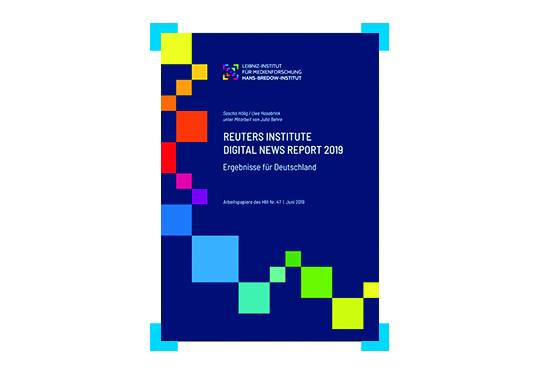
Hamburg, 12.06.2019: More than one third of adult Internet users (34%) rely on social media such as Facebook, WhatsApp or YouTube as their source for news. In the group of 18 to 24 year olds, Instagram has taken the lead. However, only ten percent of all Internet users consider social media to be the most important source, and only three percent regard them as the only source. Only 16 percent trust news from social media. These are the findings of the Reuters Institute Digital News Report, for which the Leibniz Institute for Media Research in Hamburg prepared the German part of the study. The 2019 study is based on 75,749 respondents from 38 countries.
Read More